This is how we explored Germany and Austria in just seven days. Below, we’re sharing our full itinerary. Including what we did each day, where we ate, and the practical tips that helped us plan the trip. We visited Innsbruck, Munich, Seefeld, and Neuschwanstein Castle, and based ourselves in locations that kept driving times under an hour and a half, which made the trip feel relaxed rather than rushed.
One of our goals was to wake up on Christmas morning surrounded by snow, and we were lucky enough to experience exactly that. If you’re planning a winter road trip through this part of Europe, this itinerary should help you do it smoothly and efficiently.

Should I rent a car?
Definitely rent a car. We highly recommend doing this when exploring these areas. It gives you so much freedom because you don’t have to rely on train schedules, and you can see many beautiful little villages that you can only reach by car. Just make sure you choose the option with winter tires in the winter, as the roads can be icy.
Day 1: Innsbruck & Mittenwald
We arrived in Innsbruck in the afternoon of the 24th of December and saw the city in the evening. We then left in the afternoon of the 31st after exploring Innsbruck in the morning, which meant we got a full day of sightseeing split into two parts.
As soon as we arrived in Innsbruck, picked up our rental car, and headed straight to the Hard Rock Café for our Christmas Eve dinner. We booked Hard Rock Café weeks in advance because it was the only place where we could find availability, and we wanted to make sure we had a reservation.
Ideally, we were hoping to change it to something more authentically Austrian, but that wasn’t possible because that is when Austria has their main meal for the holidays (instead of the 25th). In the end, we actually really liked Hard Rock, and we were very happy to be there.
After lunch, we walked through the Märchengasse, or Fairy Tale Alley, in the Old Town. Here, you can see many facades decorated with characters from classic storybooks like Rapunzel, Pinocchio, Hänsel and Gretel, and more. This isn’t actually historical, as it’s a modern addition that was added to the Old Town around 28 years ago.
Innsbruck is also known for its famous Golden Roof on Herzog-Friedrich-Straße. As we arrived, there was a live Christmas performance happening on the balcony of the Golden Roof. This is a yearly Advent tradition, where choirs and brass players perform old Christmas songs. After this, we were quite tired and headed to where we would be staying for the rest of the trip.

Where We Stayed (and Why Location Made This Trip So Easy)
We stayed in Mittenwald, in the south of Bavaria, to be close to places in both Germany and Austria, and it turned out to be a great decision. The longest drive we did was 1 hour and 39 minutes to Munich on day seven, and it was only 40 minutes to and from Innsbruck airport.
Mittenwald became known for violin making in the 1600s, when local maker Matthias Klotz learned the craft in Italy and brought it back home. His work turned the town into an important center for violins sold across Europe. Today, the tradition continues through a violin-making school and small workshops, and there is also a Violin Making Museum called the Geigenbaummuseum.
Day 2: Mittenwald’s Old Town & Seefeld Austria
On day two, we woke up to snow all around us, which was a dream come true.
We walked to the Old Town from our hotel (about a 10 min walk) and had our Christmas lunch at a typical German guesthouse restaurant called Alpenrose in Mittenwald. Guesthouse restaurants are very common here. We ordered duck with German dumplings (called Knödel) and purple cabbage, which is very typical in Bavaria, as well as three different types of schnitzel. One was breaded with pepper sauce, one came with a creamy mushroom sauce and dumplings that look like pasta called Spätzle, and another was served with a creamy sauce and potato croquettes. We also ordered Augustiner beer from Munich, the capital of Bavaria. For dessert mom ordered something called a Germknödel. A large, dome-shaped sweet yeast dumpling filled with spiced plum butter, popular in Southern Germany and Austria.
After lunch, we walked around Mittenwald and absolutely loved seeing all the beautiful houses covered in ornate paintings. This mural style paintings on the buildings are known as Lüftlmalerei, a type of fresco painting that is typical of the Bavaria and Tyrol regions.

Seefeld Austria
In the afternoon we drove to Seefeld in Austria, an alpine town in the state of Tyrol, about 20 minutes from Mittenwald. There, we came across a small Christmas market covered in snow in the Dorfplatz by St. Oswald Church. There were outdoor fireplaces, so we warmed up with eggnog and warm buttery pretzels. It was my first time trying eggnog and I wasn’t a fan, but mom really enjoyed it.
We also walked around to see the Seekirche behind the ice rink, which is connected to the Olympia Sport and Congress Centre. In winter, you can enjoy the saunas there or relax on the lounge chairs inside while looking out at the snowy view from the pool.
Day 3: Unterammergau, Neuschwanstein Castle, Füssen
On day three, we had lunch in Unterammergau, about a 45-minute drive from Mittenwald, at a guesthouse restaurant called Ferienwohnungen im Gasthof Stern.
Two of us ordered the duck with dumplings and purple cabbage, along with an orange panna cotta, which was delicious, especially the cabbage and dumplings with the gravy. To be completely honest the panna cotta was strange and we would probably never eat it like that again but it did taste good and we appreciate the chef’s attempt to do something different. The other two ordered roasted pork with pork crackling and two types of dumplings, knödel which is bread based and klöße which is potato based. The pork was tender and absolutely delicious. The waiter was dressed in typical German clothes and the service was excellent. We loved the cozy atmosphere of the restaurant.

Neuschwanstein Castle
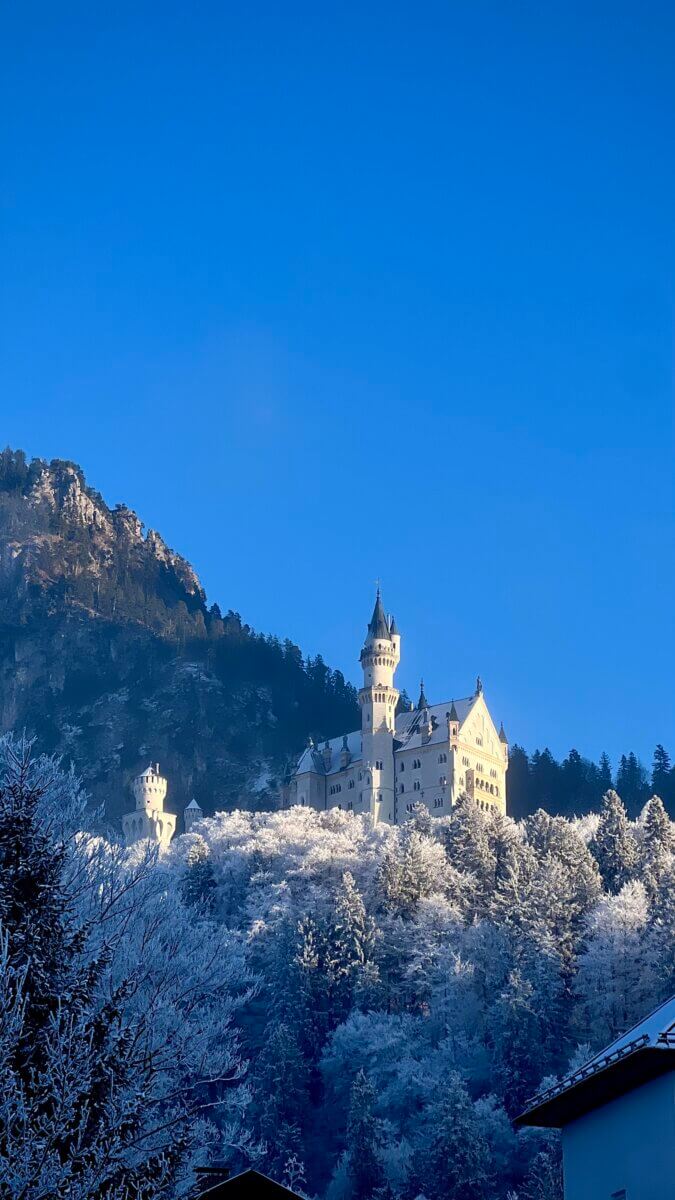
After lunch, we drove to Neuschwanstein Castle. Unfortunately, we couldn’t see it up close because we didn’t leave early enough. Make sure to go in the morning, especially in winter, as sunset is early at around 16:30. It’s definitely worth seeing the inside if you can, but visits are only possible with a guided tour. I’ll leave the ticket link in the description. For a magical experience, you can also go up to the castle by horse carriage, which costs 8 euros per person.
Instead, we decided to visit the nearby town of Füssen. We came across a few Christmas market stalls selling Glühwein, and we ordered both the white and red versions. Definitely try the white one if you haven’t, it’s something different and you’ll be pleasantly surprised. They also had Irish coffee, which we had never seen at a Christmas market before. After that, we visited the church at Hohes Schloss Castle, which was incredibly beautiful. Since it was freezing outside, we stopped for coffee at Füssener Kaffeerösterei, where they grind the beans on site using coffee from all over the world. We liked this coffee shop, but it was quite busy and there weren’t many tables available.
The Weather During Our Trip + What We Actually Wore
Most days we had clear skies and temperatures around 0°C (32°F), which was cold but manageable. However, once the sun went down, it got much colder. All the way down to -8°C (17°F) sometimes. Make sure to pack gloves, fleecey thermal layers, beanies or earmuffs, warm socks, and proper winter shoes or boots, as most places we visited had snow, so non slippery soles.
It snows across all of these areas, which makes them great for skiing. There are plenty of ski resorts, especially in places like Garmisch, a town we visit on day 5, which is home to a highly rated ski resort. One day, while driving back, we passed the slopes as they were being prepared for the FIS Ski Jumping World Cup. Funny enough, we ended up watching the competition on TV a few days later once we were back home.
Day 4: Relaxing day in Mittenwald
On day four, we decided to take a rest day and slow things down. I went into town in Mittenwald to get pastries, which turned into quite the adventure because everything was closing at 1 pm. I arrived at 12:45, and most bakeries were already empty or running out of options. I did manage to find apple strudel, plum tart, blueberry tart, and a few other pastries from café Obermarkt and Eiscafé Venezia and they were ok. For the rest of the day, we stayed in and relaxed, which is very necessary sometimes.
Day 5: Garmisch & Oberammergau
On day five, we drove to Garmisch-Partenkirchen, about 25 minutes away. And immediately saw a board saying: Winter Park (Christmas market), which had lots of food stalls and an ice rink. We had no idea it was there and were pleasantly surprised. We absolutely loved it and could have stayed all day. We ordered hot Aperol, which had mixed reviews. I loved it, but my mom thought it tasted like cough medicine.
For food, we chose cheese-filled sausages in a roll with mustard, and from another stall, we ordered knödels. You could choose up to three flavors, so we tried bacon and cheese, spinach, and tomato. They were served with brown butter sauce, topped with parmesan, and placed on a bed of lamb’s lettuce. Unreal.
We then walked around town, admiring the traditional artwork painted on many of the buildings. We bought cakes to go at Krönner Coffee House and Confectionery, a traditional German-Austrian café that has been around since 1934. At a nearby souvenir shop, we bought two Christmas ornaments for the tree. A nutcracker and a cable car with skis from a place called Alpenwelt Garmisch.
As it got colder, we found an alpine-style Christmas market with cozy seating areas and blankets. We ordered a hot chocolate, which was delicious, and everyone there was incredibly friendly. Before leaving, we visited St. Martin Parish Church. And were especially impressed by the painted ceiling. On the drive back, we passed through Oberammergau, and even from the car, it looked like one of the most beautiful towns we saw.

Day 6: Snowy drive, Cable car & Mittenwald
Our plan for day six was to take a snowy drive and see some lakes. The drive itself felt like a winter wonderland. With frozen landscapes and sunshine making the snow sparkle. We did get to see a frozen section of Sylvensteinsee while waiting in traffic on the Faller-Klamm Bridge. Unfortunately, the road was closed, and it didn’t look like we would get through, so we had to turn around.
That turned out to be a blessing in disguise, because we found a cable car in Kochel am See that takes you from the village of Walchensee up to Fahrenberg mountain on the upper slopes of Herzogstand. Tickets cost 21 euros round trip for adults and 6 euros for children under 15, and the last trip down is at 16:15 (this is of course the winter timetable). The views from the top were absolutely gorgeous, and we highly recommend doing this. There’s also a café at the top where you can enjoy a drink with the view.
For dinner, we ate at a tiny Christmas market in Mittenwald with just two stalls, one selling German sausages in a roll and the other selling mulled wine and other drinks. Originally, we wanted to go to a restaurant, but everything was fully booked. Even on a Monday in a small town, reservations are essential. In the end, we really enjoyed the market atmosphere and the cozy vibe.

Day 7: Munich Germany
On day seven, it was time to drive to Munich. The drive was only 1 hour and 40 minutes. We parked at a paid parking lot called Max-Joseph-Platz and visited Dallmayr.
Dallmayr Munich
Dallmayr is a centuries-old luxury store in the heart of Munich. It has a high-end grocery market, a famous coffee and tea brand, a café, and a Michelin-starred restaurant. The market section sells cheeses, fresh produce, seafood, meat, and prepared meals that all looked amazing. Next to it is the gourmet section with teas, coffees, chocolates, and jams. Upstairs is the restaurant.
The boys ordered lobster soup. However, we chose the Christmas set lunch menu, which included tomato soup and duck breast with mashed potatoes and purple cabbage for 35 euros. You can also add dessert for 39 euros. After lunch, we went to Marienplatz to see the huge Christmas tree and the famous Glockenspiel. Just keep in mind that it only runs from March to October, with shows at 11 am, 12 pm, and 5 pm. There are no winter shows.

St. Peter’s Tower
For panoramic views of Munich, we highly recommend going up St. Peter’s Tower. It costs 5 euros and has 306 steps. It’s not for the faint of heart or anyone with a fear of heights. But, the views at the top are absolutely worth it.
Afterwards, we picked up pastries at Zöttl, including a wild berry-filled krapfen (doughnut), a vanilla krapfen, and a nussbreze filled with ground nuts.
Kaiserschmarrn in Munich
You must try Café Kaiserschmarrn. They mainly serve Kaiserschmarrn and you can sit inside cable car-style huts. It looked incredibly cozy. Kaiserschmarrn is shredded pancake fried in butter and served with powdered sugar and jam or apple sauce, and we absolutely love it.
For more delicious kaisserschmarrn in Budapest we had some in a beautiful restaurant if you’re interested in checking that out.
Lego store Munich
If you like Lego, make sure to visit the Lego store, where they’ve built detailed models of Munich and traditional German items and even a spectacular lego painting of Neuschwanstein Castle.

Leave a Reply